Author: Josef Dominik
Translation: Ignatova D.V., marketing specialist LLC ZVK "BERVEL"
According to data provided by NASA's Corrosion Laboratory at Kennedy Space Center, the cost of metal corrosion in the United States is approximately $276 billion per year. This huge amount includes direct and indirect costs associated with corrosion. In the United States, according to the latest data, damage from corrosion and the cost of combating it amounted to 4-5% of GDP. This figure is growing every year. According to environmental statistics, more than 250,000 tons of sulfuric acid falls each day as acid rain in the northern hemisphere. According to experts, corrosion “eats” more than 5 tons of steel every second. Therefore, it is worth once again thinking about the problem of corrosion.
Corrosion Prevention
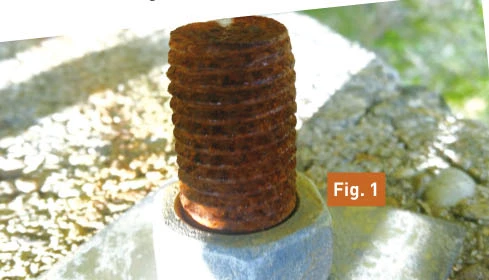
It is estimated that more than 25% of damage from corrosion could be avoided by prompt use of anti-corrosion products. A prerequisite for effective prevention of corrosion is knowledge of all corrosion processes, as well as the properties of the metal used and the state of the environment. A typical example of incorrect compliance with these simple conditions is shown in Fig. 1. It has been emphasized many times that the fight against corrosion begins at the design and construction stage. Rice. Figure 2 demonstrates the poor design of an indoor swimming pool.
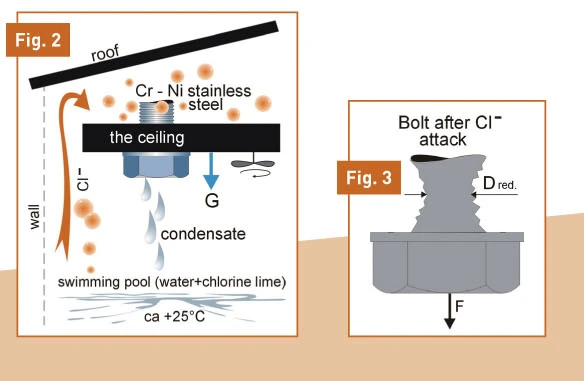
In this case, the designer attached support bolts made of stainless chromium-nickel steel to the concrete ceiling. It was assumed that all the parameters and dimensions were made correctly, but it turned out that a serious mistake was made. The designer did not take into account the fact that in order to comply with sanitary and hygienic standards, the water in the pool is regularly chlorinated. Chloride vapors penetrated into the space between the ceiling and the roof and, as a result, corrosion of the stainless chromium-nickel steel began. As is known, this type of steel is not resistant to chlorine, so the problem of weakening the cross-section of the bolts arose (Fig. 3). As a result, the entire ceiling collapsed. Moreover, external inspection of the support bolts was not carried out.
What useful information can be gleaned from this case?
1. Even stainless steel is susceptible to corrosion under certain conditions.
2. Effective corrosion prevention requires perfect knowledge of the effects of the environment on the properties of metals.
3. Support bolts should be subject to regular external inspection.
4. The water treatment technology in the pool was not taken into account by the designer.
5. Poor quality of design documentation.
There are many similar examples of corrosion. The main reason for the premature occurrence of corrosion is the human factor, that is, neglect and underestimation of the importance of the problem of corrosion protection at the design stage. Corrosion is a multi-stage, complex process that must be studied holistically. Only after studying the very essence of the corrosion process and the types of corrosion can one begin to study and develop protection methods.
From a practical point of view, it is effective to divide corrosion into visible, less visible and invisible. The first group includes surface corrosion. Surface corrosion is characterized by uniform destruction of metal over the entire surface. This is the least dangerous type of corrosion because it can be easily detected and repaired.
However, there are more dangerous, less noticeable types of corrosion:
• local corrosion;
• contact corrosion;
• intergranular corrosion;
• corrosion cracking.
The most dangerous type of corrosion is invisible intercrystalline (intercrystalline) corrosion. In this case, destruction occurs along the boundaries of the crystals and the outer surface of the metal does not have noticeable traces of corrosion.
Hydrogen embrittlement of metal is especially dangerous (Fig. 4), since the manifestations are almost impossible to notice even under a microscope. High-strength steels are most susceptible to hydrogen embrittlement. Corrosion prevention in this case is based on dehydration or the use of embrittlement-resistant alloys. To ensure the prevention of hydrogen embrittlement in steels with a strength of more than 1000 N/mm2, it is advisable to use “currentless” galvanizing methods, during which hydrogenation of parts does not occur. These include hot-dip galvanizing, zinc lamel coatings, Dacromet type coatings and others based on highly dispersed zinc.
Conclusions
In conclusion, it is worth noting that corrosion has always existed and will exist. Without a doubt, billions of dollars in annual losses have led people to fight against these harmful effects. We can say with confidence that all types of corrosion lead to the loss not of the metal itself, but of valuable metal structures, the construction of which costs a lot of money. It is worth remembering that premature failure of the structure due to corrosion can lead to unforeseen consequences. Unfortunately, the problem of corrosion cannot be avoided, but any problem can be solved with a properly organized, competent approach. There are many “keys” (methods) to preventing corrosion, but they must be applied early and correctly.
Date: 05/03/18
Source: Fastener World Inc.